Geothermal Solar Thermal Thermostats: Hybrid System Comparison
By Aiko Tanaka • 29th May
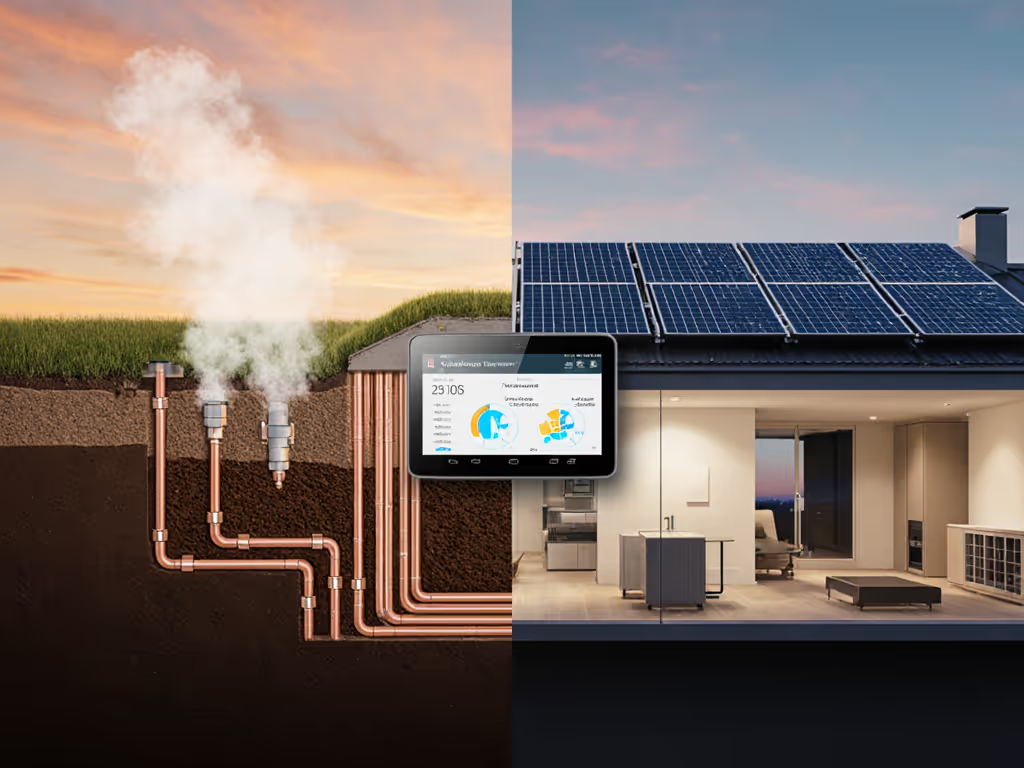
A geothermal solar thermal thermostat is not a single standardized product but a control strategy: it is the way your main thermostat, heat pump controller, and solar thermal controller work together so the most efficient source delivers heat first, with predictable comfort and safe equipment behavior. In practice, a good dual renewable energy thermostat setup is built from a capable multi-stage or heat-pump thermostat plus dedicated solar and hydronic controls, all arranged so that if the WAN dies, your core heating still works. For thermostats that keep core functions running offline, see our smart thermostats with local processing guide.
1. Foundations: geothermal vs. solar thermal (and what thermostats actually see)
Before comparing control options, it helps to clarify what each technology is really doing from the thermostat's perspective.
What is "geothermal" in a residential context?
In most homes, geothermal means a ground-source heat pump (GSHP) that moves heat between your house and the ground via buried loops or wells.[2] Instead of burning fuel, the heat pump uses electricity and exploits the relatively stable ground temperature to move heat in or out of the building.[2]
From the thermostat's point of view, a GSHP usually looks like a heat pump with one or more stages, possibly with an auxiliary heat source (electric resistance or a fossil backup). The thermostat is mainly deciding:
- When to call for heating or cooling
- Which stage(s) to use
- When to allow or lock out auxiliary heat
What is solar thermal in this picture?
Solar thermal (solar hot water) systems capture the sun's energy to heat water, typically using roof-mounted collectors, then store that heat in a tank or other reservoir.[1] That hot water can be used for domestic hot water, pool heating, and in some designs, to assist space heating.[1]
A solar thermostat or solar controller in such systems usually compares the temperature of the solar collector to the storage tank and runs a pump when solar gain is available.[1][10] To the room thermostat, this solar side is usually "invisible"; it just sees a hot water source or buffer tank managed by a dedicated solar control.
In hybrid systems, the main room thermostat does not "control the sun" directly; it controls demand for heat, while separate controllers decide which source (ground loop, solar tank, boiler) can satisfy that demand.
2. FAQ: Do I need a special "geothermal solar thermal thermostat"?
Q: Is there a single thermostat that natively manages both geothermal and solar thermal?
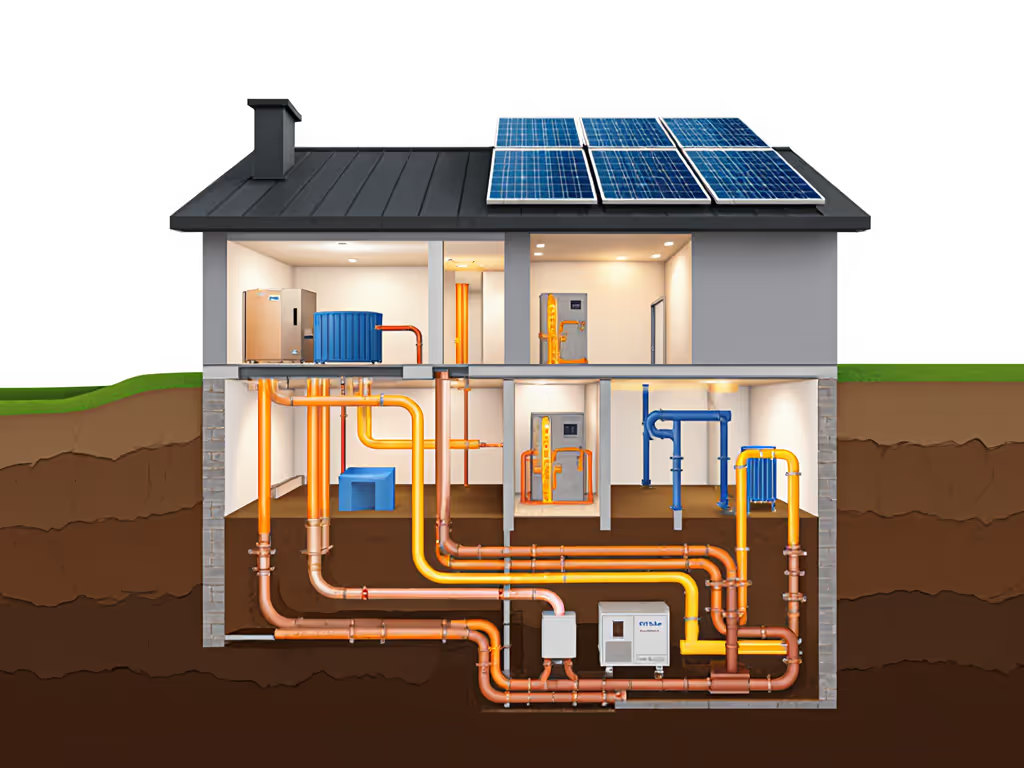
A: For typical residential systems, no. You do not usually buy a single box labeled "geothermal solar thermal thermostat." Instead, you design a control architecture built around:
- A heat-pump-capable thermostat (often 24V) for your GSHP and air handler / hydronic valves
- A solar thermal controller (often differential, based on temperature sensors) for the collectors and storage tank[1][10]
- Sometimes, a hydronic or buffer-tank controller that decides which source (GSHP, solar, boiler) feeds your heating loop
This three-part architecture is far more flexible and serviceable than trying to force one wall device to handle every edge case.
Q: So what does "dual renewable energy thermostat" really mean?
In practice, a dual renewable energy thermostat is any thermostat and control stack that can:
- Work cleanly with a ground source heat pump integration (multi-stage heat pump logic, aux lockout, etc.)
- Coordinate with solar thermal by respecting tank temperatures, external calls, or priority logic managed by a hydronic controller
- Maintain comfort and safe operating limits even if cloud connectivity is lost
The label is less important than the dependency diagram: how each controller depends on sensors, networks, and each other.
3. Architectural patterns: how do these systems connect?
Pattern 1: GSHP for space heating + solar for domestic hot water only
This is the most common and simplest pattern:
- GSHP handles all space heating and cooling via ductwork or radiant distribution.
- Solar thermal preheats domestic hot water in a separate tank, often with a backup electric or gas heater.[1]
- The room thermostat only cares about air or room temperature; it has no direct interaction with the solar system.
In this case, any saving energy thermostat that is compatible with your GSHP can work; the solar thermal behaves like a separate appliance.
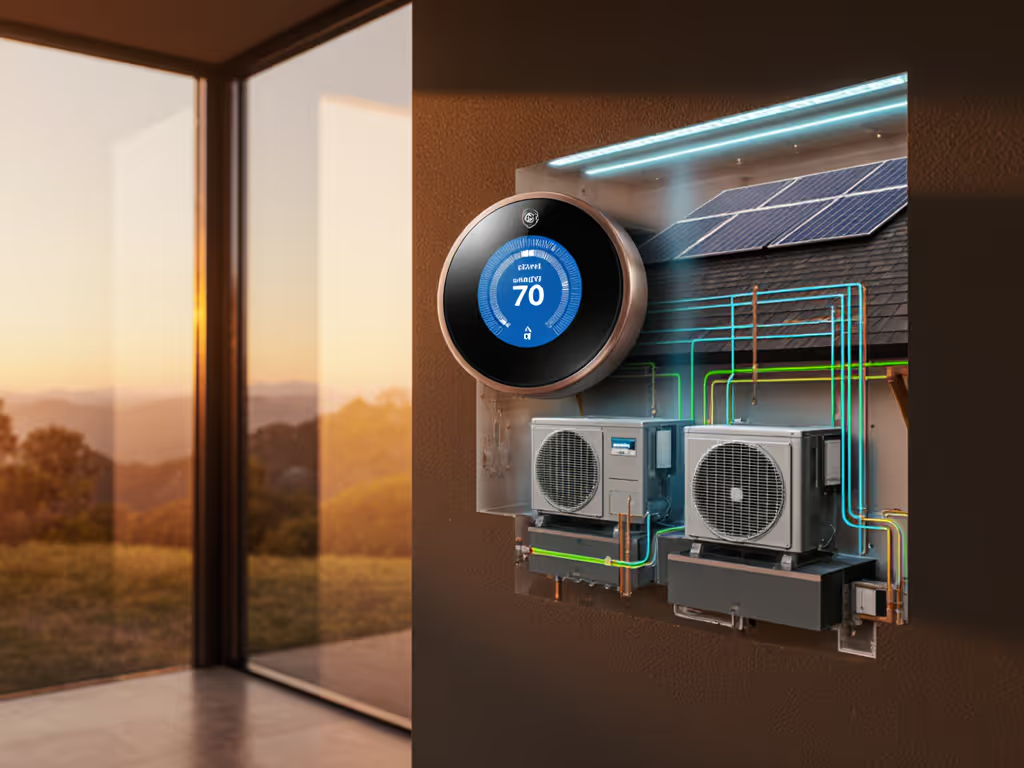
Pattern 2: GSHP + solar thermal feeding a buffer tank for space heating
Here, both renewable sources can contribute to space heating:
- Solar thermal heats a storage tank when collector temperature is high enough.[1][10]
- GSHP can either draw from that tank or provide heat directly to the distribution loop.
- A hydronic controller or tank manager gives solar priority when tank temperature is high, and calls on the GSHP (or boiler) when it is not.
- The room thermostat calls for heat; downstream logic decides which source to use. For geothermal-specific control tuning like aux heat lockouts and staging, see geothermal thermostat optimization.
This pattern gives higher renewable utilization but requires more thoughtful controls and a clear dependency map so that no controller is "fighting" another.
The key design question I always ask: If the WAN dies, what still works? Your control chain should keep at least one safe, efficient heating path fully local.
4. FAQ: Can mainstream smart thermostats handle ground-source heat pumps?
Q: Is a ground-source heat pump different from an air-source heat pump from the thermostat's perspective?
Electrically and logically, a GSHP often looks like a standard heat pump with one or more compressor stages and possibly auxiliary heat; the difference is in the outdoor unit and ground loop, not in the thermostat contacts.[2] Many smart thermostats that support multi-stage heat pumps can therefore control compatible GSHPs, as long as wiring, staging, and O/B reversing valve conventions match the equipment.
However, you must confirm:
- Number of stages (1-2 compressor stages, auxiliary heat stages)
- Reversing valve control (O vs. B) if your GSHP uses one
- Power type (24V low-voltage vs. line-voltage for some pumps or valves)
Install manuals and manufacturer compatibility lists remain the definitive sources for this; they are more reliable than generic marketing claims.
Q: What about Nest Learning Thermostat compatibility?
Many GSHP systems that present as standard multi-stage heat pumps can be wired to popular thermostats, including those marketed as learning thermostats. For brand-specific guidance, see our Nest compatibility check for geothermal heat pumps. Industry practice and user reports indicate that nest learning thermostat compatibility depends less on the fact that the unit is "geothermal" and more on whether:
- The heat pump uses standard low-voltage terminals ( Y1/Y2, G, O/B, W1/Aux, C, etc.)
- The number of stages does not exceed what the thermostat can handle
- There is a solid C-wire or approved power solution
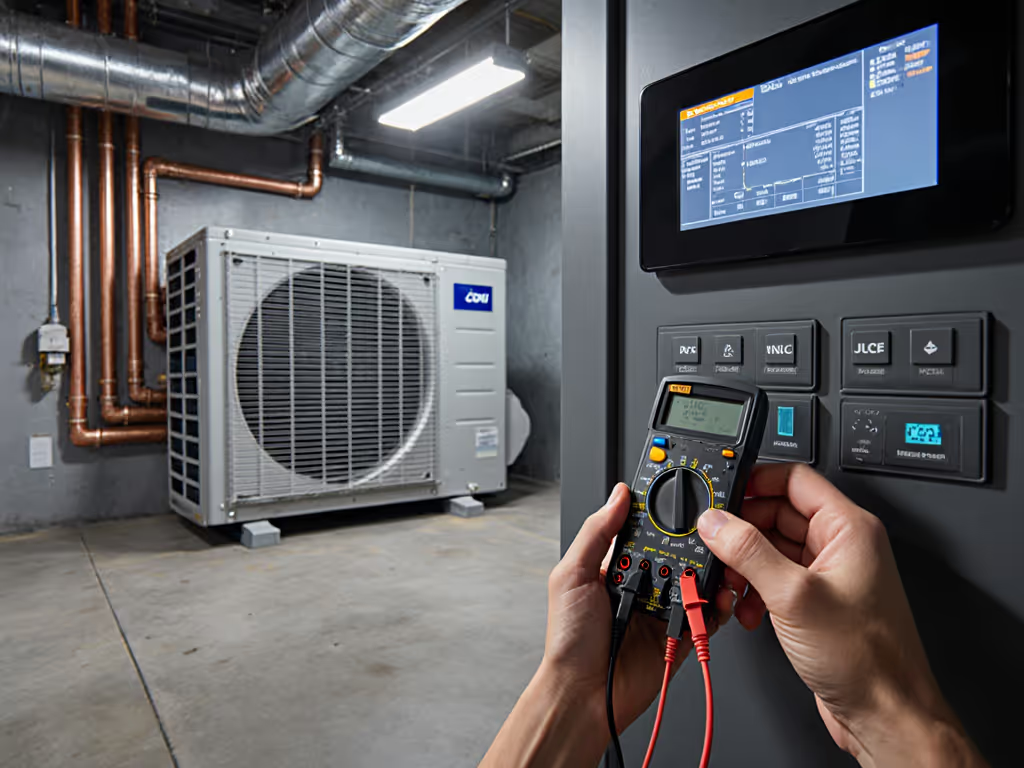
For advanced hydronic GSHP systems (e.g., water-to-water with complex mixing valves), the main control is often a dedicated heat pump / hydronic controller, and the wall thermostat becomes a simple demand signal (or is replaced by zone controllers).
Q: Does the thermostat see solar thermal at all?
Usually, no. A solar thermal coordination controller runs the collector pump when the collector is hotter than the tank and stops it when not.[1][10] The thermostat may indirectly "feel" solar by seeing a higher tank temperature, but the logic about when to harvest solar is handled locally on the solar controller.
5. Key thermostat capabilities for geothermal + solar hybrids
When you choose a thermostat for a hybrid system, the question is not "Does it say geothermal on the box?" but "Does it support the control logic my architecture needs?"
5.1 Multi-stage and auxiliary heat logic
For GSHPs, you want a thermostat that supports:
- Multi-stage compressors (Y1/Y2) with configurable staging behavior
- Auxiliary heat with adjustable lockout temperatures
- Compressor protections (minimum off time, short-cycle prevention)
This allows you to:
- Prioritize high-efficiency GSHP operation and limit costly aux heat
- Match the thermostat's staging to the equipment's capabilities
5.2 External inputs and hydronic coordination
In some advanced systems, the buffer tank or hydronic controller can signal the thermostat or a supervisory controller when:
- Solar-heated water is available
- The tank temperature is above/below a threshold
Most residential wall thermostats have limited support for direct tank temperature inputs, so coordination is usually done at the hydronic controller level, not the thermostat. The thermostat simply demands heat; the hydronic controller decides whether solar, GSHP, or a boiler delivers it.
5.3 Local vs. cloud behavior
For hybrid systems, I strongly favor devices whose core functions continue fully local:
| Capability | Local (on-device) typical behavior | Cloud-dependent behavior (varies) |
|---|---|---|
| Schedules & setpoints | Stored and executed on thermostat | Some apps push cloud-based schedules |
| Basic heat/cool calls | Driven by local temperature sensors and setpoints | N/A |
| Occupancy / geofencing | Via local sensors; some support local presence logic | Phone-based geofencing often cloud-mediated |
| Energy reports / insights | Limited runtime data on-device | Detailed analytics usually cloud-generated |
| Remote control (phone, web) | Via local LAN if supported; cloud for outside access | Typically requires vendor cloud |
| Demand response / utility programs | May accept external dry-contact inputs | Cloud-triggered events in many implementations |
Local first, cloud optional (comfort shouldn't hinge on an outage).
If you are on HomeKit or Matter/Thread, look for thermostats that:
- Expose all core modes and setpoints locally via the home hub
- Keep schedules on-device
- Allow overrides locally even if the app or vendor cloud is unreachable
This is where a hybrid system can shine: thermal mass in the ground and in storage tanks buys you time; the thermostat must not be the single point of cloud failure.
6. FAQ: How exactly is solar thermal "coordinated" with the thermostat?
Q: Who decides when solar thermal runs?
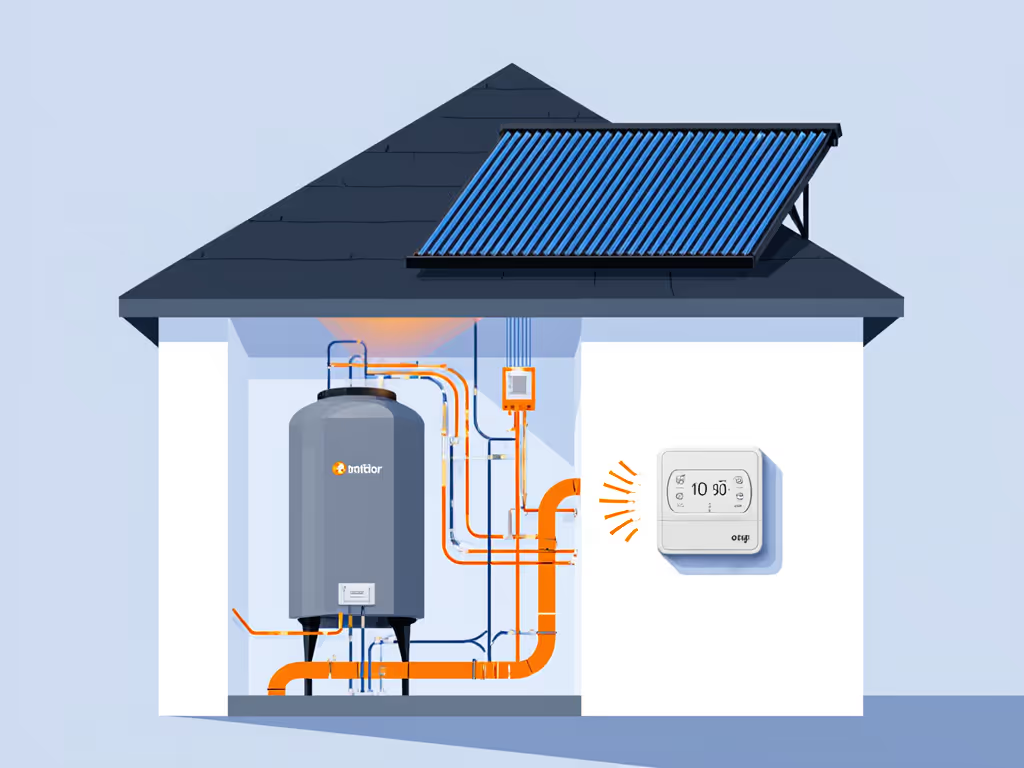
The solar controller (effectively a specialized thermostat) looks at:
- Collector temperature
- Tank temperature
When the collector is hotter than the tank by a certain differential, the controller runs the pump to collect heat; when not, it stops.[1][10] This is entirely independent of your wall thermostat.
Q: How does the room thermostat influence solar usage?
There are two common approaches:
-
Solar-priority via tank temperature logic
The room thermostat calls for heat. If the hydronic controller sees the tank is sufficiently hot (thanks to solar), it circulates from the tank. If not, it calls on the GSHP or boiler. The thermostat is unaware of which source is used. -
Time-of-use and setpoint strategy
In some systems, you may raise the heating setpoint slightly during hours when solar gain is expected (or electricity is cheap), letting the building and buffer tank store heat, then coast when conditions are less favorable. If you’re on variable pricing, our time-of-use thermostat picks explain features that automate these strategies. This is a thermostat-level strategy layered on top of the solar controller's basic job.
In both cases, the thermostat's role is to shape demand, not to micromanage the solar equipment.
7. Failure-mode walkthrough: outages, sensor faults, and controller failures
Complex hybrid systems are only as good as their failure planning. A few scenarios I consider mandatory to map:
7.1 Internet or cloud outage
If your thermostat's schedules and core logic are cloud-based, an outage can leave your GSHP operating in last-known state or defaulting to unsafe assumptions. In contrast, a local-first thermostat with on-device scheduling continues to:
- Maintain heating and cooling within your chosen bands
- Honor compressor protections and aux lockout
- Operate without your phone app
In one storm scenario I worked through with a client, internet was down for two days. Their radiant floors (backed by a heat pump and solar tank) held a narrow temperature band purely on local schedules and local sensors; the app simply showed 'offline'. Nearby homes with cloud-dependent control apps had to revert to manual overrides and less efficient modes.
Hybrid systems have inherent resilience (the ground and water tanks store energy), but only if control is equally resilient.
7.2 Sensor failures (tank, collector, or room)
- If a collector sensor fails, a well-designed solar controller should fail-safe by stopping the pump to avoid overheating or freezing.[1][10]
- If a tank sensor fails, the hydronic controller should fall back to a conservative mode (e.g., GSHP or boiler only) and raise an alert.
- If a room thermostat sensor drifts or fails, the thermostat may overshoot or undershoot; good models provide calibration and clear error messaging.
Document how each device behaves on sensor fault. This is part of a proper failure-mode analysis. For longevity and calibration planning, review our 3-year thermostat sensor drift analysis.
7.3 Controller failure
Map out:
-
What happens if the solar controller dies?
Usually you lose solar contribution, but GSHP and any boiler should still run. -
What happens if the thermostat fails?
Many air handlers or hydronic systems have manual overrides or service jumpers, but you may lose normal control until the thermostat is replaced.
In your own notes, I recommend a one-page dependency diagram showing which pieces can fail without losing all heat. For each box, annotate: "Needs internet?" "Needs cloud account?" "Manual fallback?"
8. FAQ: Is a geothermal + solar hybrid, with a sophisticated thermostat, worth the complexity?
Q: Where do the savings really come from?
The biggest efficiency gains are usually from the equipment and solar collection, not the thermostat itself:
- Ground-source heat pumps can deliver several units of heat for each unit of electricity by leveraging relatively stable underground temperatures, rather than creating heat by combustion or resistance.[2]
- Solar thermal can provide a significant fraction of domestic hot water energy in suitable climates, and can contribute to space heating when properly sized and controlled.[1]
The thermostat's role is to protect and orchestrate that efficiency by:
- Minimizing auxiliary heat usage
- Using time-of-use strategies (preheating/precooling) where applicable
- Avoiding short cycling and respecting equipment limitations
A good saving energy thermostat in this context is one that never undermines what geothermal and solar thermal are already giving you.
Q: What about comfort and hot/cold spots?
Hybrid systems often pair well with:
- Remote room sensors for better temperature averaging
- Zoned controls that can prioritize key rooms
These features are thermostat-dependent but are orthogonal to the geothermal and solar aspects. If you struggle with room-to-room balance now, choose a thermostat ecosystem that supports sensors and zoning cleanly, then integrate that with your GSHP and hydronic controls.
9. Where to go from here: building your own control map
If you are planning or tuning a geothermal + solar thermal system, the next steps are less about product shopping and more about clear system design:
-
Draw a simple dependency diagram
Include: GSHP, solar collectors, storage tank, any boiler/backup, pumps, valves, room thermostat, solar controller, hydronic controller, home hub, and cloud. -
Mark what stays local vs. what needs the cloud
Ask for each box: If the WAN dies, what still works? Ensure at least one efficient heating path remains fully local. -
Confirm thermostat compatibility from equipment manuals
Treat manufacturer wiring diagrams and compatibility tables as your source of truth, especially for multi-stage GSHPs. -
Decide which controller arbitrates between heat sources
In most residential hybrids, that will be a hydronic or buffer-tank controller, not the wall thermostat. -
Plan for future upgrades
If you might add zones, change from furnace + AC to GSHP, or expand solar thermal, choose a thermostat and control stack that won't need replacement with every equipment change.
There is no one-size-fits-all "geothermal solar thermal thermostat," but with a clear architecture and a local-first mindset, you can turn powerful but opaque equipment into a predictable, resilient comfort system that behaves the way you expect (on good days and during outages alike).
Related Articles