
Steam Heating Thermostat Comparison: Testing Nest Compatibility
By Erik Müller • 19th Mar
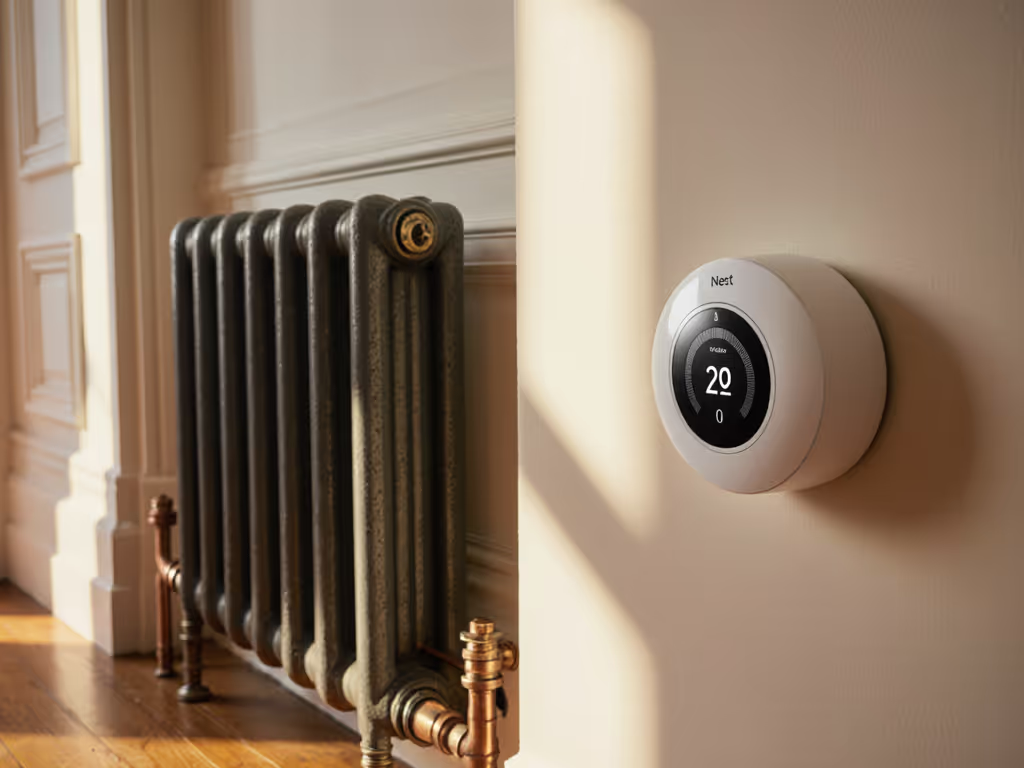
Choosing the right steam heating thermostat isn't just about finding a smart device that connects to your phone. If you're evaluating whether a Nest learning thermostat works with your steam system, or comparing it to Honeywell, Ecobee, or other options, you'll quickly discover that steam and forced-air heating live in different worlds, and most mass market thermostats were designed for the latter.
I've spent years tuning thermostats for older homes with steam radiators and hydronic systems. The hardest part isn't the installation. It's the realization that comfort isn't a setpoint, it's a graph. Flat lines, gentle curves, no spikes. Once that clarity took hold, every comparison I ran afterward started with the same question: Will this model let me flatten the curve?
Why Steam Systems Demand a Different Thermostat Strategy
A steam radiator system takes hours to reach full heat after a cold start. That thermal inertia (the lag between when your boiler fires and when rooms stop feeling chilly) confuses most programmable thermostats. They were built for forced-air furnaces, which respond in minutes. Nest and many other learning thermostats use algorithms that predict and "learn" your household's heating patterns, but steam systems expose a fatal flaw in that logic: the device overshoots, short-cycles, or locks you into rigid schedules because it can't account for steam's slow ramp. For a deeper look at brand differences, compare learning thermostat performance.
Two thermostat settings matter most for steam:
-
Cycles per hour (CPH): The number of times your boiler fires and shuts down each hour. A steam system burning fuel just to reach temperature, then shutting down seconds later, wastes energy and produces uneven heat. Most steam installers recommend 1-3 CPH; higher settings (6-12 CPH) are common on forced-air but destroy comfort in steam.
-
Adjustable differential: The temperature range (often called deadband) between when the boiler ignites and when it shuts off. A 3-degree differential (heating from 67°F to 70°F, then cycling off until it drops to 67°F) produces longer, fewer cycles. A 1-degree swing creates short, wasteful bursts.
Nest doesn't expose either of these settings. It treats every heating system the same. That's the first incompatibility to understand.
Nest Compatibility: What It Can and Can't Do
Nest is easy to install on a 2-wire steam thermostat setup if you have an older home, it doesn't always demand the extra C-wire (common/24 volt return) that newer thermostats require. That's a genuine advantage for retrofits. The app is intuitive, and remote control from anywhere feels like progress.
Here's what many users report: Nest's learning algorithm works against steam's rhythm. It tries to anticipate your heating needs by studying past behavior, but steam's long warmup time breaks that pattern every time the boiler was idle overnight. The thermostat bumps up the setpoint to compensate, the boiler fires longer than necessary, and you're paying more while comfort stays uneven. Some owners also experienced unexpected offline episodes during winter software updates (a scenario where losing thermostat control during freezing weather is unacceptable). If uptime matters, see thermostats with offline control to avoid cloud-dependence surprises.
Nest does work with steam systems if you disable learning and use manual scheduling, but at that point you've paid smart-thermostat prices for a dumb thermostat's functionality. You've also lost the remote-sensor advantage: Nest doesn't support external room sensors, so cold bedrooms on the second floor stay cold.
The Honeywell T-Series and Proven Alternatives
Honeywell's T-Series (including the TH6220U and higher models) and mid-to-upper-range Vision Pro models are the recurring recommendation across professional forums because they expose the settings steam actually needs.
These models offer:
- Independent CPH settings for heating and cooling, adjustable from 1 to 12
- Wired room sensors (indoor or outdoor), so you can place a sensor in that drafty hallway and flatten the curve before cold spots develop
- Heat anticipation controls, a feature inherited from analog thermostats that older steam systems depend on
- Multiple wiring paths, so they work with 2-wire, 3-wire, and 4-wire setups without forcing a C-wire upgrade
Ecobee SmartSi is another solid choice if you need WiFi and remote sensors. Installation is straightforward, and the accompanying app is less invasive than Nest. However, Ecobee doesn't expose CPH or differential the way Honeywell does, so tuning requires workarounds.
Robertshaw and Aprilaire thermostats also appear frequently in steam-specialist conversations, valued for adjustable differential and reliability over 50 years of use. They're less glamorous and often lack WiFi, but they're bulletproof on one-pipe steam systems.
Sensor Placement and CPH Tuning: The Real Efficiency Win
I mapped my partner's discomfort one winter: the living room sat at 72°F while the upstairs hallway, where our boiler's thermostat was mounted, was a chilly 65°F. The boiler kept shutting off to "protect" the hallway, leaving radiators upstairs idle. The setpoint looked fine, but the comfort graph was a sawtooth.
I added a wireless sensor (compatible with the Honeywell T-Series) in the hallway, nudged the CPH from 4 down to 2, and set an auxiliary lockout so overnight heating didn't fire unless the house dropped below 62°F. The curve flattened overnight. Mornings felt even. Our gas bill stopped seesawing because fewer, longer burns mean the boiler reaches efficient steady-state before shutting down.
The lesson: Flatten the curve, then judge. You can't optimize a thermostat without visibility. Runtime and duty-cycle charts are essential. Most WiFi models log this data, but you must actively review it, looking for patterns of short cycles, unexpected reheats, or temperature swings. Our guide to smart thermostat energy reports shows exactly what trends to analyze.
Nest doesn't provide this level of granularity. Honeywell T-Series and Ecobee both expose cycle data via apps or HomeKit integrations, but it's often buried. Real efficiency tracking requires either a separate monitoring device or your own manual logging. Yes, that sounds analog. But for steam systems, that's how you get past guesswork.
Installation and Wiring Realities
Many older homes with steam systems were wired for analog thermostats: often just two wires (heating and ground). Adding a smart thermostat sometimes requires running a third or fourth wire from your boiler control to bring in the 24-volt common (C-wire). Honeywell makes this simpler because many models work without a dedicated C-wire, instead harvesting power from the heating circuit itself.
Nest requires a C-wire or a Nest Power Connector (a separate device). If you don't have one and won't run new wire, you're blocked. Ecobee includes a 5-to-4-wire adapter for setups where you control both heating and cooling with only four wires. Read the wiring diagram for your specific model, mislabeling a wire or forcing polarity on a steam system control can damage the boiler's relay board. If you're weighing installation options, our DIY vs pro wiring guide breaks down cost, time, and risks.
A Decision Framework
Here's how to evaluate thermostat options for your steam system:
-
Check CPH and differential controls. Can you adjust them? Honeywell T-Series and some Aprilaire models: yes. Nest and many smart thermostats: no.
-
Verify sensor compatibility. Do you have uneven heating across zones? Add a wireless or wired room sensor. Honeywell and Ecobee support this. Nest does not.
-
Test wiring feasibility. Do you have a C-wire? Many steam homes don't. Honeywell T-Series often works without it; Nest requires one or a workaround. Before choosing Nest, run through our Nest compatibility checklist for wiring and system matchups.
-
Plan for data logging. Can you see runtime, cycle frequency, and setpoint history? This is how you diagnose whether your chosen thermostat is actually tuning correctly.
-
Consider upgrade scope. Are you planning to convert to a heat pump later? Ensure your chosen model supports staging and aux-heat lockout, not just on/off heating.
The Bottom Line
Nest is a capable thermostat for some homes, but it's not optimized for steam. Its ease of installation and polished app mask the fact that it disables the knobs you need to turn on a steam system. Honeywell T-Series models, Ecobee, and traditional Aprilaire or Robertshaw options each have trade-offs, but they all expose the controls that matter: CPH, differential, and remote-sensor integration.
Comfort is a graph, flat lines, gentle curves, no spikes. Choose a thermostat that lets you measure and adjust toward that goal, not one that pretends it knows what your old house needs. The right match isn't the smartest device; it's the one that listens when you tell it how your home actually heats.
Start by logging your current temperature and runtime for a week using a portable sensor or manual notes. That baseline tells you whether your next thermostat choice is solving a real problem or just adding complexity. Then compare the models that expose adjustable CPH, support room sensors, and work with your existing wiring. Test one, monitor the curves, and refine. That's how you move from comfort guesswork to measurable certainty.
Related Articles