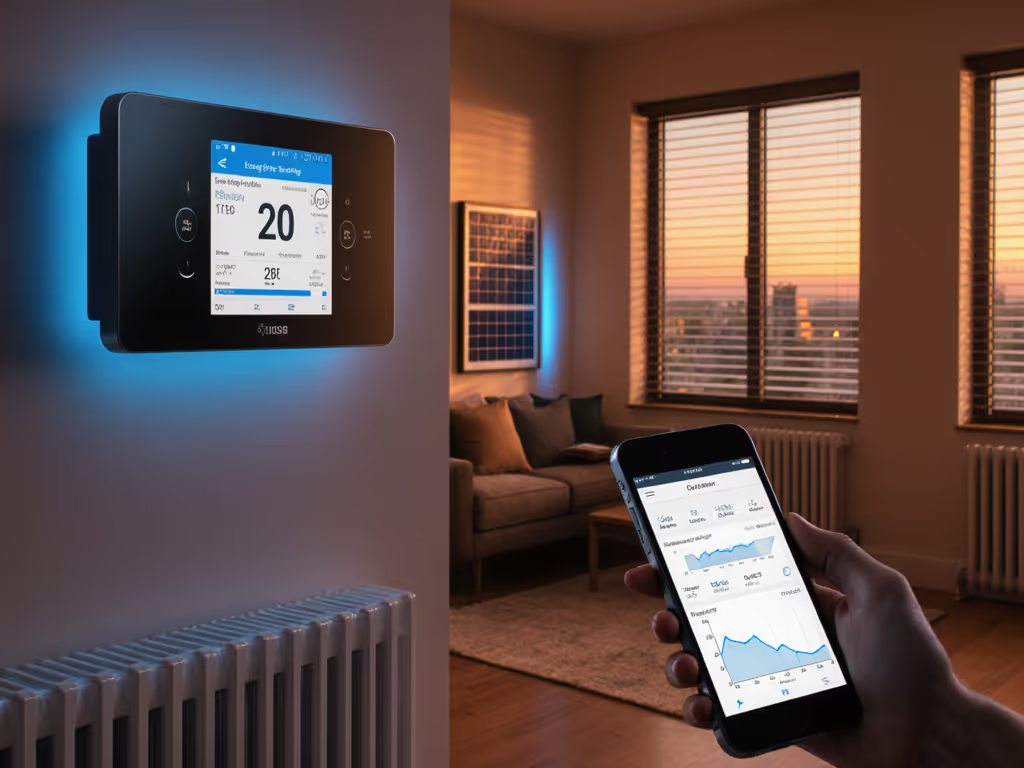
7 Best Fireplace Thermostat Integration Models
By Mateo Alvarez • 6th May
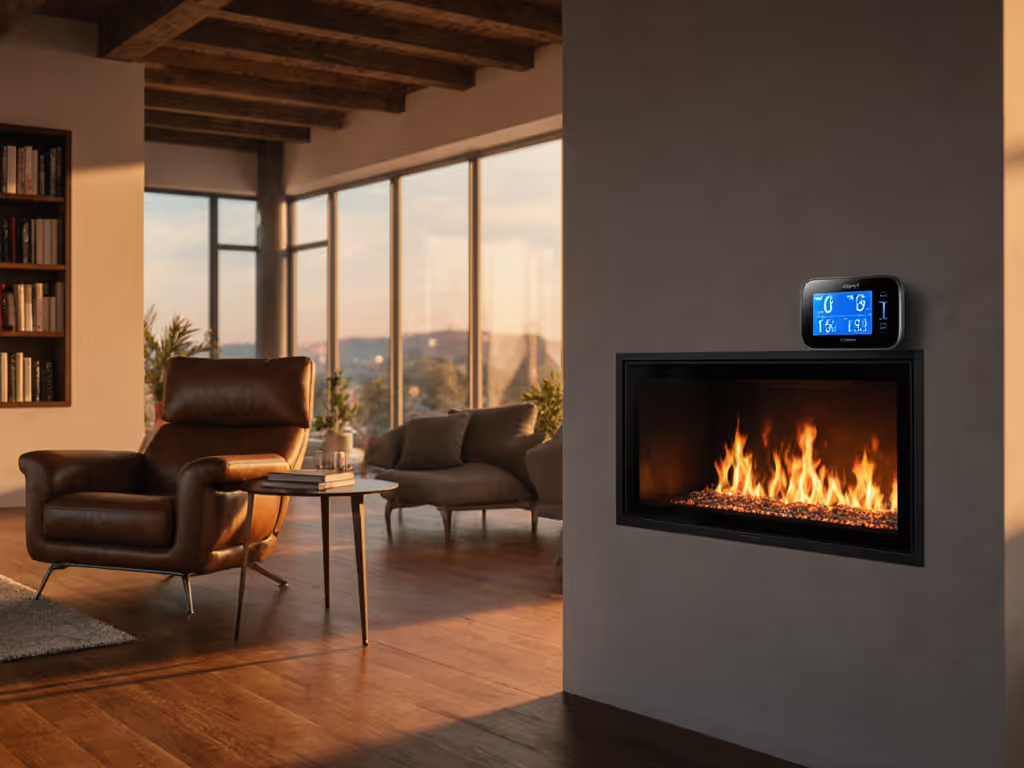
Fireplace thermostat integration has evolved from a simple on/off switch to a sophisticated part of home energy management. If your home relies on a fireplace as supplemental heat (or if you're coordinating it alongside your primary heating thermostat for fireplace homes), choosing the right integration model can mean the difference between predictable savings and a comfort surprise. This guide walks you through seven proven approaches, each analyzed for compatibility, demand response readiness, and override clarity.
Why Fireplace Thermostat Integration Matters
Supplemental heating sources like fireplaces and wood stoves often operate outside your main thermostat's control loop. When a utility program kicks in a demand response event, or when time-of-use rates shift, your fireplace heating coordination strategy determines whether you save money or simply shift load from one fuel to another. For a deeper primer on events and incentives, see our demand response guide. The key insight: a thermostat is only as useful as its transparency. Assumptions drive outcomes. Check yours before enrolling.
Most homeowners don't realize that pairing a fireplace with a smart thermostat requires explicit wiring, a clear override mechanism, and written assumptions about what happens during peak events. When my parents enrolled in their utility's winter peak program, we tested three different fireplace pre-heat profiles against their main thermostat setpoints. The best result came not from the fanciest algorithm, but from a device with a manual override button and an hourly runtime log we could export. Enroll smartly: incentives matter, but override must be obvious.
1. Standalone Programmable Fireplace Thermostat (Non-Communicating)
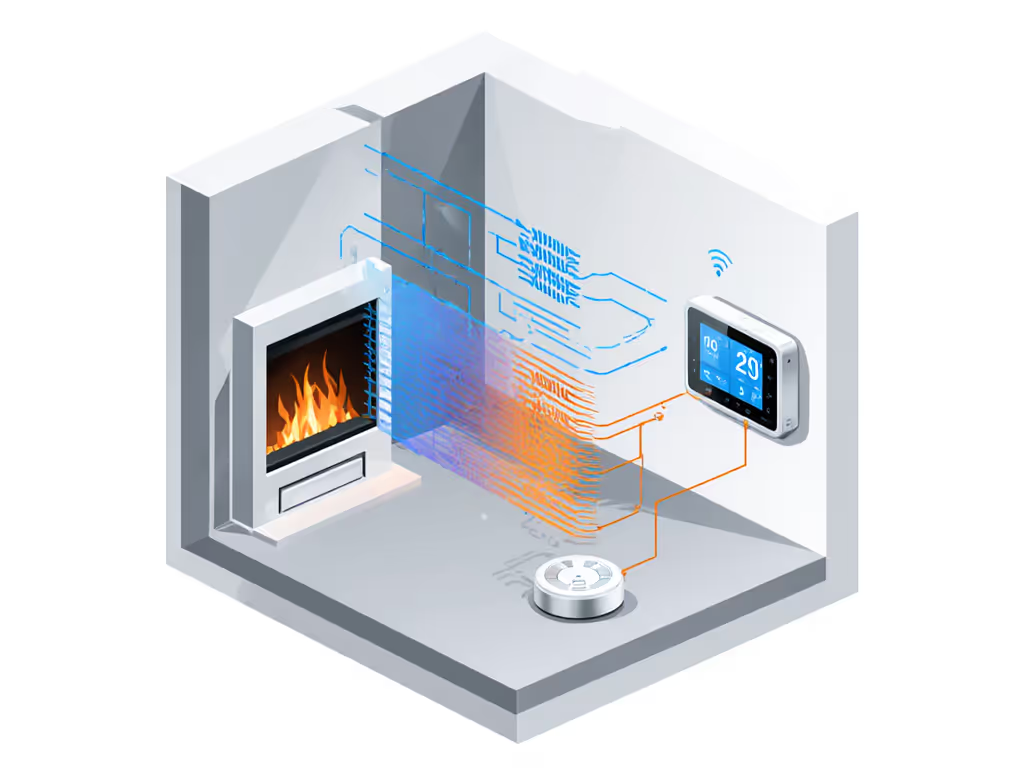
What it is: A wall-mounted or handheld thermostat dedicated to the fireplace circuit, independent of your home's main HVAC thermostat. Examples include the Flameworks Non-Programmable Vertical Mount and basic millivolt models.
How it integrates: Your fireplace runs on its own temperature schedule, separate from furnace and AC. You set a fixed setpoint (e.g., 68°F) and the thermostat maintains it by triggering the fireplace's IPI module (Intermittent Pilot Ignition) when the room temp drops below set temperature.
Assumptions & Payback:
- Cost: $60-$180 depending on features and installation complexity.
- Heating season impact: If your fireplace adds 15,000-25,000 BTU/h and runs 4-6 hours per day during cold months, you may offset 10-20% of furnace runtime, depending on thermostat setpoint coordination.
- Clear assumptions: Fireplace costs ≈ $0.50-$1.50 per therm (natural gas) or $2-$4 per cord (wood); furnace costs ≈ $0.70-$1.20 per therm. Savings depend on fuel price spread and your willingness to lower the main thermostat by 2-3°F when fireplace runs.
- Utility rebate eligibility: Rarely qualifies on its own, but may support demand response if the device has a hardwired demand signal input.
Pros:
- Simple wiring (millivolt units need only two wires to fireplace valve).
- No subscription or WiFi dependency; fully manual control.
- Predictable behavior; no learning algorithms that can overshoot setpoints.
- Clear override: turn it off manually anytime.
Cons:
- No remote control or app integration; you adjust on-site or via handheld remote only.
- No occupancy detection or time-based scheduling (non-programmable versions).
- Cannot coordinate with main thermostat to avoid simultaneous heating and unnecessary run-time.
- Excluded from most demand response programs that require smart, remotely-controllable devices.
Best fit: Homes with older fireplaces lacking WiFi infrastructure; owners who want simplicity and manual control first. Secondary heat source, not primary comfort driver.
2. Smart WiFi Fireplace Thermostat with App & Scheduling
What it is: A WiFi-enabled fireplace thermostat (e.g., Skytech Smart Stat II/III) that connects to your home network and a mobile app, allowing remote on/off, temperature adjustment, and simple scheduling (e.g., "on at 6 PM, off at 11 PM").
How it integrates: Your fireplace thermostat becomes a networked device tied to your smartphone and possibly your smart home platform (Google Home, Alexa). For mobile control usability and reliability differences, see our Ecobee vs Nest app comparison. You can automate schedules and receive alerts if the fireplace is running unexpectedly.
Assumptions & Payback:
- Cost: $180-$350 (device + professional install, if needed).
- Seasonal savings scenario: Programmable schedule reduces fireplace run-time by 2-4 hours per week during heating season by avoiding unnecessary overnight firing. At $0.80/therm (20,000 BTU/h fireplace), that's $15-$30 per month during winter peaks. Payback: 6-18 months if you also reduce main thermostat use.
- Utility rebate eligibility: Some utilities (especially those running demand response pilots) offer $50-$150 rebates for smart fireplace controls that can respond to demand signals. Check your utility's HVAC/heating equipment list.
Pros:
- Remote control from phone app; adjust temperature anywhere.
- Simple scheduling (e.g., pre-heat before you arrive home on cold mornings).
- Often compatible with Alexa/Google voice commands ("Alexa, set fireplace to 70°F").
- Real-time runtime notifications help spot unexpected usage.
- Clearer data logging than standalone units.
Cons:
- Requires stable WiFi; outages or ISP downtime = loss of remote control (though manual override usually remains).
- App reliability varies by brand; some users report lag or cloud synchronization delays.
- Does not integrate with your main home thermostat; you control fireplace and furnace separately, risking unnecessary simultaneous heating.
- Demand response capability depends on utility's specific integration; not all WiFi thermostats are certified for all programs.
- Monthly or annual subscription may apply for premium features (data history, advanced scheduling).
Best fit: Tech-savvy owners who want remote control and basic scheduling, and whose utilities offer demand response rebates or programs. Supplemental heat in dual-fuel or heat pump homes where you want to minimize expensive auxiliary heat.
3. Demand Response Ready Fireplace Control (Utility-Certified)
What it is: A fireplace thermostat or relay module specifically certified by your local utility for demand response enrollment. These devices receive a hardwired or wireless signal from the utility during peak periods and can automatically reduce fireplace output or staging (e.g., from "high" to "low" or off entirely).
How it integrates: Your fireplace operates normally until a demand response event is triggered. The device then either:
- Shuts off the fireplace entirely for 15-60 minutes (you keep a manual override).
- Reduces flame output to a minimal level to maintain comfort without peak load.
- Preheats the home before an event window to reduce firing during the peak.
Assumptions & Payback:
- Cost: $200-$500 (device + utility rebate typically covers 50-75%).
- Demand response incentive: Utilities typically offer $50-$250 per heating season if your fireplace control participates in events. Event frequency varies: 5-15 events per winter in aggressive programs.
- Payback example: If your fireplace cuts 5 kW for 1 hour during 10 winter peak events, and your utility pays $10-$20 per event, you earn $100-$200 per season. Device cost may be fully offset by rebate plus incentives within year one.
- Critical assumption: Demand response works only if your thermostat/relay is on the utility's certified equipment list. Enroll smartly: check your utility's website before buying.
Pros:
- Highest incentive payouts (utility rebates + event incentives often total $200-$400 over 2-3 years).
- Automatic peak-shaving saves you from manual intervention; comfort usually unaffected if setpoint is pre-optimized.
- Some models include exportable data on event response, helping you verify savings and dispute any billing anomalies.
- Utility coordination ensures device firmware and safety settings are validated.
Cons:
- Device must be on utility's approved list; not all WiFi fireplaces qualify.
- Enrollment process can be slow (4-8 weeks); model approval sometimes delayed.
- Events are non-negotiable once enrolled (though override always available); some users feel loss of autonomy.
- Data is often shared with utility; privacy-conscious owners should review data-sharing terms.
- May require an Ethernet or cellular gateway for two-way communication; additional hardware cost.
Best fit: Owners in regions with aggressive utility demand response programs (California, New York, Texas, Midwest utilities). If your fireplace is your primary backup heat, this model ensures you get incentivized to reduce peak load without sacrificing comfort.
4. Zoned Supplemental Heat Integration with Smart Thermostat Bridges
What it is: A hybrid setup where your fireplace (and/or wood stove) is controlled by a relay module wired to your main smart thermostat (e.g., Ecobee, Nest, or Honeywell Home). The main thermostat acts as the master controller, triggering the fireplace as a "second stage" heater after the first stage (furnace/heat pump) runs.
How it integrates: Your fireplace thermostat becomes a secondary "auxiliary heat" output on your main thermostat's wiring. When the room temperature falls 2-3°F below setpoint, the main thermostat energizes the fireplace relay. This staged approach ensures your most efficient heat source (furnace or heat pump compressor) runs first; fireplace kicks in only when needed.
Assumptions & Payback:
- Cost: $300-$700 (smart thermostat + compatible relay module + install).
- Staging benefit: If fireplace costs $1.50/therm and furnace costs $0.85/therm, staging ensures furnace covers 70% of heating load (the efficient part), and fireplace tops up only during deep cold snaps. Over a season, this could reduce overall heating cost by 5-10%, especially in heat pump homes where auxiliary heat is expensive.
- Heat pump advantage: If converting from furnace to heat pump, this model lets you keep the fireplace as a backup without rewiring. Payback: 2-4 years via reduced compressor runtime in extreme cold.
Pros:
- Automatic, intelligent staging; comfort is optimized without manual override needed.
- Integrates with main thermostat's learning and scheduling (e.g., Nest's Eco mode can lower main setpoint and trigger fireplace preemptively).
- Time-of-use friendly: if your utility charges high rates 4-9 PM, you can program thermostat to rely on fireplace instead of furnace during those hours (if TOU rates are available).
- Humidity and humidity control often available on main thermostat; extends to fireplace integration.
- Data logging happens at thermostat level; easier to correlate furnace + fireplace runtime and billing.
Cons:
- Wiring complexity: requires spare wire from furnace control board to thermostat and then to relay (24V common wire usually required).
- If main thermostat fails or loses WiFi, fireplace may not trigger properly (though manual override persists).
- Relay modules add complexity; if relay fails, fireplace won't respond to thermostat signals (manual mode only).
- Not all smart thermostats support native relay outputs; may require third-party integrations (Home Assistant, SmartThings) that introduce additional failure points.
Best fit: New smart thermostat installations or retrofit scenarios where you want tight coordination between primary and supplemental heat. Heat pump + fireplace backup homes seeking to minimize expensive auxiliary heat.
5. Heat Pump Dual-Fuel Integration with Fireplace Backup
What it is: A modern heat pump system (air-source or ground-source) paired with a fireplace as an auxiliary heat source. The thermostat controls both the heat pump compressor (preferred in mild/cool weather for efficiency) and the fireplace (triggered in extreme cold when compressor efficiency drops below breakeven). Some utilities now offer enhanced incentives for dual-fuel + fireplace coordination.
How it integrates: Your smart thermostat (e.g., Ecobee Smart Thermostat with Voice Control, Honeywell Home T9) includes a dedicated "auxiliary heat" output wired to a fireplace relay. For brand-by-brand strengths and setup tips, see our dual-fuel thermostat comparison. The thermostat measures outdoor temperature and calculates a "balance point" (the outdoor temp below which the heat pump's cost per BTU exceeds the fireplace cost). Below that point, fireplace runs preferentially.
Assumptions & Payback:
- Cost: $600-$1,200 (heat pump upgrade or retrofit + integrated fireplace relay).
- Efficiency breakeven: Most air-source heat pumps reach 95% system efficiency (including compressor and resistance) down to ≈32°F. Below that, auxiliary resistance heat kicks in, costing $1.20-$1.80/therm. Fireplace at $1.50/therm becomes competitive.
- Seasonal savings scenario: If your winter has 40 days below 32°F and your home loses 100,000 BTU/day on those days, transitioning even 30% of that load to fireplace saves ≈0.3 MMBtu/day × 40 days = 12 MMBtu. At $1.50/therm (100 kBTU), that's ≈$180/season. Payback: 3-5 years if combined with utility rebate.
- Utility rebate eligibility: Many regions offer $500-$1,500 rebates for heat pump + fireplace combinations, recognizing the demand response value. Some programs require a smart relay module to track fireplace usage and verify demand reduction.
Pros:
- Best-in-class efficiency: heat pump efficiency is maximized for mild weather; fireplace cost is minimized for extreme cold.
- Demand response upside: utilities pay premium incentives for homes that intelligently shift auxiliary heat to alternative sources (fireplace, natural gas).
- Data transparency: most modern thermostats export hourly runtime for both heat pump and fireplace, enabling clear ROI analysis.
- Future-proof: if you add more zones or a ductless mini-split later, the relay module stays in place.
- Climate resilience: fireplace provides heat even if the grid fails or heat pump fails (local, distributed backup).
Cons:
- Highest upfront cost: heat pump retrofit alone is $4,000-$8,000; adding fireplace relay and integration adds $200-$500 more.
- Demand response participation required by some utilities; this means your fireplace behavior is logged and monitored (privacy trade-off for incentives).
- Thermostat algorithm must be tuned correctly; misconfigured balance point leads to short-cycling (fireplace firing constantly, efficiency drops).
- Fireplace must be in same thermal zone or well-connected for staging to work; room-to-room temperature stratification can confuse the algorithm.
Best fit: Cold-climate homeowners converting from fossil fuel furnace to heat pump, or new construction in zones with aggressive heat pump adoption incentives. Ideal if your fireplace is already present and functional; integrating it maximizes rebate and demand response incentives.
6. Wood Stove Temperature Control & Fireplace Coordination
What it is: An integrated system where wood stove temperature control is linked to your home's main thermostat, usually via a thermostat-actuated damper or blower that responds to room temperature and setpoint. Some systems add a fireplace thermostat to the logic, creating a tiered heat priority (furnace → wood stove → fireplace, or similar).
How it integrates: A wall-mounted thermostat (smart or dumb) measures room temperature. When setpoint is approached, a motorized damper on the wood stove chimney partially closes, reducing draft and slowing burn rate. If room exceeds setpoint, damper closes fully or a blower ramps down. A separate fireplace heating coordination relay may trigger the fireplace only if both furnace and wood stove are insufficient (3-stage heat).
Assumptions & Payback:
- Cost: $400-$900 (damper kit + thermostat + install).
- Wood stove efficiency gain: Manual wood stoves burn wood inefficiently if not monitored (overfiring = heat up chimney). An actuated damper can improve overall system efficiency from ≈65-75% (manual) to ≈80-85% (thermostat-controlled). If you burn 3-5 cords/season at $200-$300/cord, a 10-15% efficiency gain saves 0.3-0.75 cords, worth $60-$225/season. Payback: 2-4 years.
- Wood cost assumption: Seasoned hardwood is ≈9 kWh/lb and costs $0.015-$0.025/kWh delivered (all-in). Gas furnace costs ≈$0.015-$0.025/kWh. Wood is cost-neutral to slightly cheaper, but labor-intensive; automation improves ROI.
Pros:
- Precise burn-rate control; no overfiring or room overheating followed by rapid cooling.
- Can integrate with smart thermostat via relay or proprietary app (e.g., Ecobee's HVAC relay output).
- Some advanced models include humidity sensing, preventing over-drying of wood stove heat.
- Demand response capable if integrated with a certified smart thermostat and relay.
- Wood is a renewable, local fuel; coordinates well with green energy goals.
Cons:
- Installation complexity: requires access to chimney damper and thermostat wiring; not a DIY project for most.
- Damper motor reliability is critical; motor failure means manual fallback, requiring on-site adjustment.
- WiFi versions may have lag in damper response; local sensor is more reliable (usually preferred).
- Wood stove occupancy detection is primitive; if room gets cold during overnight shutdown, restarting fire takes 30+ minutes to warm room back up.
- Integration with fireplace relay adds a third heat stage, increasing complexity and risk of miscalibration.
Best fit: Rural and semi-rural homes with existing, well-maintained wood stoves. Owners with access to cheap firewood and willingness to trade energy efficiency for fuel cost savings. Not recommended as primary heat in demand response scenarios without extensive logging and validation.
7. Time-of-Use Optimized Fireplace Preheating with Manual Override
What it is: An advanced integration model where a smart fireplace thermostat (or relay) is programmed to respond to your utility's time-of-use (TOU) rate structure. During off-peak/low-cost hours (typically 9 PM-6 AM), the fireplace preheats your home 2-3°F above comfort setpoint. During peak/high-cost hours (4-9 PM in most TOU plans), the fireplace is minimized or disabled, and the main thermostat relies on furnace/heat pump only. To choose thermostats that excel on variable rate plans, see our time-of-use thermostat guide. A prominent manual override button ensures you can restore comfort instantly if needed.
How it integrates: Your smart thermostat (or standalone fireplace thermostat) is programmed with two setpoints:
- Off-peak setpoint: 72°F (fireplace actively heats 8 PM-6 AM on winter weekdays).
- Peak setpoint: 69°F (fireplace off or minimal 4-9 PM; furnace/heat pump only). A thermostat-mounted manual override button temporarily raises peak setpoint to 72°F for 2-4 hours, letting you override the TOU schedule if needed (e.g., unexpected guest, illness, extreme cold snap).
Assumptions & Payback:
- Cost: $300-$600 (smart thermostat + relay + TOU programming + install).
- TOU savings example: If on-peak rates are $0.20/kWh (equivalent ≈$2.00/therm) and off-peak rates are $0.08/kWh (≈$0.80/therm), preheating with cheaper firepower saves ≈$1.20/therm on 30% of your winter heating load. Over 120 heating days, that's $1.20 × 3.6 MMBtu/day × 120 days × 30% ≈ $1,555/season in TOU rate arbitrage. Payback: 3-6 months if device cost is $300.
- Critical assumptions: Utility must offer TOU rates; fireplace must be operational and sized appropriately (≥15,000 BTU/h); your home must have adequate thermal mass (insulation, concrete/tile floors) to hold preheated temperature through peak window.
Pros:
- Highest ROI potential if your utility offers steep TOU rate spreads ($1.00+/therm difference between peak and off-peak).
- Manual override is transparent: a physical button, not buried in an app, ensures comfort is never compromised by automation.
- Demand response friendly: utility can layer demand response events on top of TOU preheating, providing stacked incentives.
- Data-rich: smart thermostat logs all fireplace firing, allowing you to verify savings monthly and adjust preheating strategy.
- Retrofit-ready: works with most existing fireplaces via a relay module.
Cons:
- Requires TOU rate availability; only ≈30% of US households have access to TOU rates (varies by region and utility).
- Preheating strategy relies on accurate weather prediction and home thermal modeling; if thermostat underestimates a cold snap, you may be cold during peak hours despite override.
- Some utilities restrict override frequency or impose penalties if override is used too often (check program terms).
- Complex setup: requires TOU rate structure validation, fireplace sizing check, and home thermal mass assessment. Mistakes = bill shock.
- Occupancy-based preheating is needed for additional savings; if you're not home during off-peak, preheating wastes fuel.
Best fit: TOU-enrolled or TOU-eligible homes with high-income, flexible occupancy (e.g., work-from-home, retirees, shift workers who can shift activity to off-peak hours). Owners comfortable with manual override and willing to export/analyze thermostat data monthly.
Comparison Table: Integration Models at a Glance
| Model | Upfront Cost | Seasonal Savings (Range) | Demand Response Ready? | Override Clarity | Best Use Case |
|---|---|---|---|---|---|
| Standalone Programmable | $60-$180 | $50-$200 | No | Manual button | Simple, backup heat only |
| Smart WiFi Thermostat | $180-$350 | $100-$300 | Limited | App + manual | Tech-friendly, basic automation |
| Utility-Certified DR Control | $200-$500* | $100-$200 + $50-$200 incentive | Yes | Clear override | Demand response programs |
| Zoned Smart Integration | $300-$700 | $150-$400 | Yes | Thermostat-based | Multi-stage heat priority |
| Heat Pump Dual-Fuel | $600-$1,200* | $200-$600 + rebates | Yes | Programmable | Efficient heat + backup fireplace |
| Wood Stove Control | $400-$900 | $60-$225 (fuel savings) | Limited | Manual damper | Renewable fuel, efficiency gain |
| TOU Optimized Preheating | $300-$600 | $500-$1,500 (rate arbitrage) | Yes | Physical button | TOU-eligible homes, high rate spread |
*Utility rebates typically offset 50-75% of device cost.
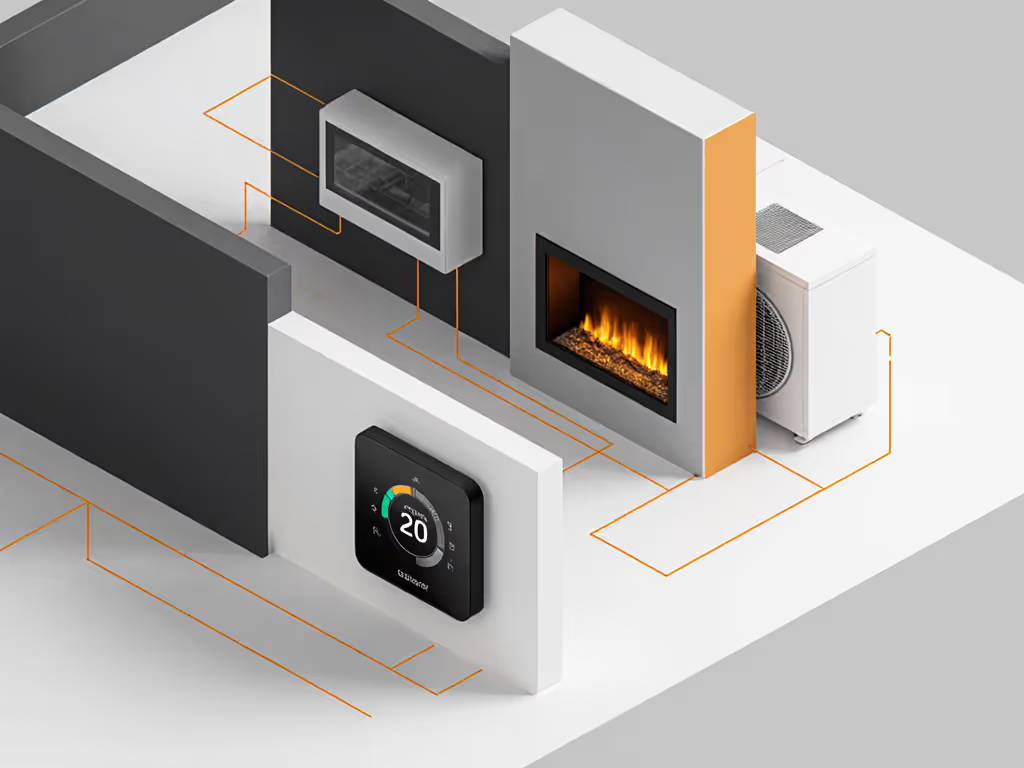
Key Wiring & Safety Considerations
Regardless of which model you choose, verify these fireplace safety thermostat features upfront:
Millivolt vs. 24V Power
- Millivolt thermostats draw power from the fireplace pilot light (≈750 mV). No external power needed; extremely reliable in outages. Wiring is simple (red/green to valve).
- 24V thermostats require a dedicated 24V transformer (often hardwired to furnace control board). Adds complexity but enables advanced features (WiFi, scheduling).
- Mismatch = failure: Connecting a 24V thermostat to a millivolt fireplace will damage the thermostat. Verify your fireplace voltage in the manual before ordering.
Thermostat-to-Furnace Coordination
- If your fireplace relay is wired to a furnace output terminal, ensure the relay is rated for the furnace's control voltage (24V AC or low-voltage DC).
- Some furnace boards (older Honeywell, Trane) have limited relay outputs; adding a fireplace relay may overload the board. Consult a technician if uncertain.
- O/B reversing valve polarity: If your home has a heat pump with a reversing valve (O = cool, B = heat), misconfigured fireplace relay can trigger the valve incorrectly, causing short-cycling and compressor damage. This is a pro-install recommendation.
Manual Override Accessibility
- Override button must be physical and always-on, not buried in an app or cloud-dependent.
- Best practice: locate override button on thermostat face, clearly labeled "Fireplace Manual On." Color should contrast (e.g., red or bright yellow).
- Test override monthly to ensure it works; app-only override (no hardware button) increases risk of being stranded during outage.
Demand Response Opt-Out
- Some utilities offer "soft opt-out" (you can disable demand response via app within event window) vs. "hard opt-out" (event is mandatory; you can only override manually).
- Check program terms before enrolling. Soft opt-out is lower-risk for comfort-conscious homeowners.
- Always confirm that override does not void rebate or event incentive; some programs penalize frequent overrides.
Narrowing Your Choice: A Decision Framework
Start with your home's HVAC type:
- Forced-air furnace + AC only → Models 1, 2, 3, or 4 work. If on TOU rates, consider Model 7. If utility has demand response, prioritize Model 3.
- Heat pump (air-source or ground-source) → Models 3, 4, 5 are ideal. Model 5 (dual-fuel) offers highest ROI if heat pump is new (rebate-eligible).
- Boiler + radiant heating → Models 2, 3, 6 only (no furnace relay board means no wired integration; WiFi or standalone models only).
- Existing wood stove → Model 6 if stove is central to heat supply; otherwise Models 1-5.
Next, check utility availability:
- Demand response program offered? Yes → Prioritize Model 3 or 5 (rebates + incentives offset 50-75% of cost).
- Time-of-use rates available? Yes → Model 7 (highest ROI if rate spread > $0.80/therm).
- Neither available? → Model 1 or 2 (simplicity and low cost are your advantage).
Finally, audit your comfort & control priorities:
- Comfort is non-negotiable → Models 4, 5, 7 (explicit multi-stage staging or manual override ensures no cold snaps).
- Low tech preferred → Models 1, 6 (minimal WiFi, local control).
- Data transparency essential → Models 2, 3, 5, 7 (exportable logs for bill validation).
- Privacy sensitive → Models 1, 2, 6 (no utility data sharing; local control only).
Summary & Final Verdict
Fireplace thermostat integration is not a one-size-fits-all decision. Your optimal model depends on your HVAC system type, utility incentive programs, and comfort philosophy.
Highest ROI (1-2 years): Model 5 (Heat Pump Dual-Fuel) in cold climates with utility rebates, or Model 7 (TOU Preheating) if your utility offers steep rate spreads and you're eligible for TOU rates. Both assume demand response or rate arbitrage; verify program terms and model approval before purchasing.
Best for simplicity & low cost: Model 1 (Standalone Programmable). No WiFi, no subscriptions, no app lag. Predictable behavior and obvious manual override. Savings are modest ($50-$200/season) but so is the investment ($60-$180).
Best for tech-forward, DIY-capable homes: Model 2 (Smart WiFi Thermostat) if you want app control and scheduling without complex wiring. Model 4 (Zoned Smart Integration) if you want the thermostat to orchestrate multiple heat sources intelligently.
Best for demand response participants: Model 3 (Utility-Certified) if your utility offers a certified fireplace control device. Incentives often total $200-$400 over 2-3 seasons, making payback 1 year or less. Critical caveat: check that your specific fireplace model is on the utility's approved equipment list before purchasing; last-minute rejections waste time and create returns friction.
Enroll smartly: incentives matter, but override must be obvious. Whatever model you choose, ensure the manual override is a physical button or switch, never cloud-dependent. Test it monthly. If your utility requires you to hide or disable override to earn incentives, the program is misaligned with comfort, and you should decline enrollment or seek a competing utility option.
Before purchase, export your fireplace operating manual, your utility's rate and program documentation, and your home's HVAC schematic (if available). Consult a technician if wiring voltage or reversing valve logic is unclear. Not sure which route to take? Read our DIY vs pro thermostat install to gauge wiring complexity and costs. A $100 pre-install consultation beats a $400 return after bricking your furnace control board.
Assumptions drive outcomes. Check yours. Model forward, override first, savings second.
Related Articles