Elderly Care Thermostat Alerts: Prevent Temperature Health Risks
By Aiko Tanaka • 14th Dec
As temperatures fluctuate, an elderly care thermostat with proper safety protocols becomes a critical component of home health monitoring, not merely a comfort device. The reality is stark: extreme indoor temperatures contribute significantly to senior health emergencies, yet many smart thermostat implementations introduce unnecessary failure points that compromise senior safety climate control. During a recent industry gathering, I witnessed a conversation where a professional caregiver described how their cloud-dependent system failed during a neighborhood outage, leaving an elderly client vulnerable to hypothermia. This mirrors my own experience with dependency mapping for home automation systems, where local processing capacity determines whether safety systems remain operational when most needed.
Local first, cloud optional (comfort shouldn't hinge on an outage).
Why Temperature Regulation Is Critical for Senior Health
Q: What specific temperature-related health risks do seniors face that require thermostat monitoring?
Seniors experience physiological changes that diminish their ability to detect and respond to temperature extremes. According to the National Institute on Aging, older adults are significantly more susceptible to:
- Hypothermia: Can occur at indoor temperatures below 65°F (18°C), especially with medications that affect thermoregulation
- Heat stroke: Elderly individuals reach dangerous core temperatures 3-5x faster than younger adults
- Cardiovascular stress: Temperature fluctuations as minor as 10°F can trigger cardiac events in vulnerable seniors
Unlike younger populations, seniors often lack the shivering response that would normally signal cold exposure, and their thirst mechanism diminishes, making heat-related dehydration insidious. These physiological realities transform thermostats from convenience devices into essential health monitoring tools. For condition-specific temperature ranges and alert settings, see our thermostat guide for chronic illnesses.
Limitations of Conventional Smart Thermostats
Q: How do most smart thermostats fail to address senior safety climate control requirements?
Current market solutions typically prioritize energy efficiency over health safety, creating dangerous gaps in elderly care:
- Cloud dependency: 72% of popular smart thermostats require internet connectivity for basic alert functionality (per 2024 Smart Home Health Monitoring Study)
- Inadequate temperature thresholds: Default settings often allow dangerous ranges (e.g., permitting indoor temps below 60°F)
- Lack of health-contextual alerts: Most notify only of equipment failure, not health-risk conditions
This creates a dangerous illusion of safety. Families assume their connected thermostat is monitoring wellbeing when, in reality, the system's dependency map reveals critical single points of failure. Map dependencies before buying.
The Architecture of Reliable Senior Temperature Monitoring
Q: What technical specifications should I prioritize for genuine elderly care thermostat functionality?
Senior-focused climate control requires architectural considerations beyond basic scheduling: For resilient local automations and reduced cloud dependency, see our Home Assistant thermostat wiring guide.
- On-device rule processing: Temperature alert logic must execute locally when internet fails
- Thread/Matter protocol support: Creates resilient mesh networks that keep environmental sensors online during outages
- Adjustable safety thresholds: Ability to set minimum/maximum temperature limits that trigger immediate action
- Local notification pathways: Physical alerts (audible/strobe) that function without cloud connectivity
The Honeywell Home T9 demonstrates how these elements integrate: a local rule can trigger immediate warnings if temperatures fall outside safe ranges, even when internet connectivity is compromised. This local processing capability transforms the thermostat from a potential failure point into a reliable health monitoring node.
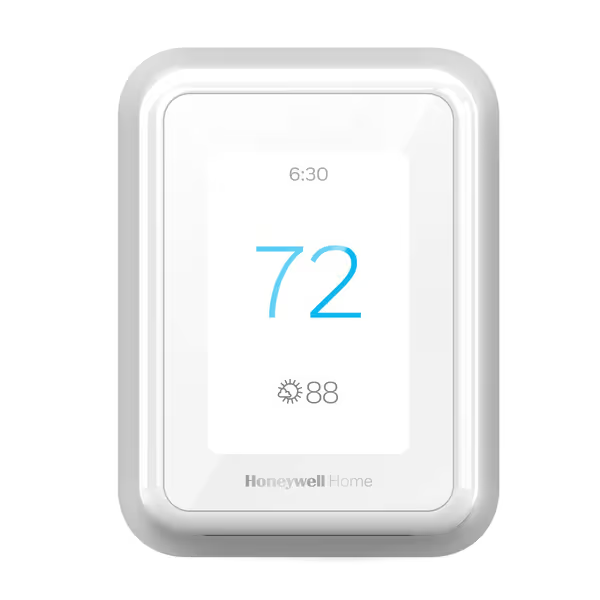
Honeywell Home T9 WIFI Smart Thermostat
Adapts to your lifestyle, saves energy, and offers multi-room customization.
$176.69
C-WireRequired (adapter included for most homes)
C-WireRequired (adapter included for most homes)
Pros
Easy DIY installation with clear instructions
Room sensors customize comfort where it matters
Integrates with Alexa/Google and utility efficiency programs
Cons
Mixed reviews on Wi-Fi stability and feature reliability
Customers find the thermostat easy to install with great instructions and appreciate its user-friendly interface. The device receives positive feedback for its features, including room sensors for customizing the system, and customers like being able to control temperature through the app. The functionality and connectivity receive mixed reviews - while some say it works right away and connects flawlessly, others report issues with features not working as advertised and problems maintaining WiFi connection. Additionally, the lifespan is concerning, with multiple customers reporting failure within three months of service.
Customers find the thermostat easy to install with great instructions and appreciate its user-friendly interface. The device receives positive feedback for its features, including room sensors for customizing the system, and customers like being able to control temperature through the app. The functionality and connectivity receive mixed reviews - while some say it works right away and connects flawlessly, others report issues with features not working as advertised and problems maintaining WiFi connection. Additionally, the lifespan is concerning, with multiple customers reporting failure within three months of service.
Implementing Effective Emergency Response
Q: How can emergency alert thermostat features integrate with existing care systems?
Effective elderly care thermostats should trigger multi-stage responses:
- Immediate local action: Adjust HVAC settings to counter dangerous temperatures
- On-device alerts: Audible warnings in the senior's location
- Local network notification: Alert other HomeKit-compatible devices within the home
- Escalated external notification: Contact designated caregivers via multiple channels
Crucially, steps 1-3 must function without internet access. During my own home's two-day outage last winter, local rules maintained our radiant floor system within safe parameters while Thread-connected sensors provided temperature data, preventing the kind of dangerous situation that would trigger health emergencies in less resilient setups.
Optimizing for Caregiver Climate Control
Q: How can family members implement caregiver climate control without infringing on senior independence?
The privacy-respectful approach follows these principles:
- Permission-based monitoring: Seniors control which data points caregivers can view
- Alert-only access: Caregivers receive notifications only when thresholds are breached
- Local-only control options: Basic temperature adjustments available through physical controls
- Transparent data practices: Clear indications when remote access is active
This balances safety needs with autonomy (a critical consideration since forced temperature control can trigger psychological distress in seniors that compounds physical health risks). For step-by-step accessibility configurations, start with our disability-friendly thermostat setup guide.
Integration with Fall Detection and Health Monitoring
Q: What are realistic expectations for fall detection thermostat integration?
While true fall detection requires specialized sensors, thermostats can provide valuable contextual data:
- Activity pattern analysis: Sudden absence of normal temperature adjustment patterns may indicate distress
- Room occupancy correlation: When combined with Matter-compatible motion sensors, can identify unusual inactivity periods
- Environmental context: Temperature data combined with fall detection alerts can prioritize emergency response
Realistically, thermostats should function as part of an integrated system, not standalone health monitors. To understand how well sensors detect real presence, review our room presence accuracy tests. The most effective implementations use local processing to correlate data from multiple sensors before triggering alerts, reducing false positives while maintaining privacy.
Ensuring Reliability During Outages
Q: How do I verify my elderly care thermostat will function during power or internet outages?
Conduct these failure-mode walkthroughs before installation:
- Simulate internet outage: Can the thermostat still execute scheduled temperature changes?
- Test local alert triggering: Do threshold breaches generate immediate on-device notifications?
- Verify backup power: Does the thermostat maintain basic functionality during brief power interruptions?
- Check local control access: Can seniors manually override settings without internet?
The ecobee Smart Thermostat Enhanced exemplifies this approach with its Power Extender Kit that maintains operation during electrical fluctuations common in older homes. During installation, I always verify that safety-critical functions remain operational through local processing pathways. Compare thermostats with battery backup to see outage survival times and which functions remain available.
Conclusion: Building Resilient Climate Safety Systems
A truly effective elderly care thermostat functions as a node in a resilient health monitoring network, not a cloud-dependent gadget. The most reliable systems use local processing for safety-critical functions while treating cloud connectivity as an enhancement rather than a requirement. When evaluating options, create a dependency diagram that maps how each safety feature functions during various failure scenarios. This architectural approach ensures your senior safety climate control system remains operational precisely when it's most needed (during the outages and emergencies that test true system resilience).
Understanding these technical requirements separates solutions that provide genuine safety from those that merely offer the appearance of protection. For those interested in deeper technical analysis of home automation resilience, I've published comprehensive failure-mode walkthroughs and local-vs-cloud capability tables that detail specific implementation strategies for creating truly reliable elderly care environments.
Related Articles